
Home › Blog
Signs of a Slab Leak in Your Newnan Home
Signs of a slab leak: a slab leak rarely announces itself with a flood; it whispers through the water bill, the floor and the quiet of the house, and here are the whispers in the order Newnan homeowners usually notice them
The first sign is the water bill. A pressurised line leaking under a slab loses water every minute of every day, and the bill is the leak's most faithful witness: a rise with no new occupants, no new irrigation, no filled pool, is water going somewhere it is not invited. Compare against the same month last year rather than last month, because seasons muddy the comparison, and treat an unexplained climb as a finding, not a nuisance.
The second sign is the meter itself, and it converts suspicion into evidence in five minutes. Turn off every tap and appliance that uses water, then watch the meter: most have a small low-flow indicator that turns when any water moves. If it moves while the house uses nothing, water is escaping somewhere in the system. The test does not say where, that is detection's job, but it ends the argument about whether.
The third sign is the floor. A hot line leaking under a slab warms the concrete and the flooring above it, producing the classic warm spot that bare feet find before instruments do. Cold lines announce differently: a damp patch, flooring that lifts, warps or softens along a line, a carpet area that stays cool and faintly musty. Floors do not change temperature or moisture on their own; a patch with a personality is a message from underneath.
The fourth sign is sound. In a quiet house, usually at night, a slab leak can be heard: a faint hiss or running-water note with no fixture open to explain it. It is the leak's own voice, the same sound the detection equipment is built to hear through concrete, and a household that notices it has located the problem to within a line, if not a spot.
The fifth sign is the structure commenting. Cracks that appear in tile or drywall along one path, doors that begin to stick on one side, a slab edge showing damp or efflorescence: water moving under a foundation moves soil and moisture with it, and the building registers the change. These signs mean the leak has seniority; it has been working long enough to alter its surroundings, and the response should match that fact rather than the leak's small size.
The sixth sign is smell and growth at the wall base: a mildew note in one room, mold appearing at a skirting board, paint bubbling low on a wall. A slab leak feeds moisture upward at the nearest path, and the wall base is where the house displays it. In Georgia's humidity many smells get blamed on the climate; a smell with an address, one room, one wall, is not the climate.
A seventh sign belongs to the subdivision age Newnan is in: the neighbour's leak. When homes built in the same season, with the same copper, on the same clay begin producing slab leaks along a street, each new one is data about your own lines. It does not mean your leak has started; it means the meter test has become worth five minutes of your year, and that a warm spot, in your house, should be believed the first time you feel it rather than the fifth.
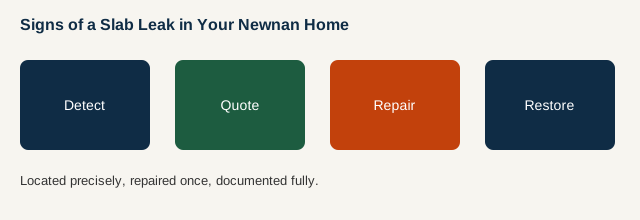
What the signs cannot tell you is which line, where along it, or what condition the pipe is in, and those three facts are the entire price structure of the repair. That is why the sequence in this trade is signs, then detection, then repair, in that order. The homeowner's job ends at recognising the whisper; everything after it is instruments.
If your home shows two or more of these signs together, the economical move is a detection visit while the leak is still a whisper. Every week a pressurised leak runs, it buys more damage with your water: more bedding washed from under the slab, more flooring fed, more claim to argue. Slab leaks are the rare household problem where time is quite literally metered, and the meter is running.
The household guidance collected by https://www.epa.gov/watersense runs through both posts: find leaks while they are small, and keep the evidence. If you would like the facts for your own home, a detection visit answers signs of a slab leak with a location and a written finding instead of opinions.
Frequently asked questions
Does this apply to homes outside Newnan?
The physics applies anywhere with slab construction and ageing copper. The local detail, red clay, subdivision ages and water, is Coweta County's, and it is why scopes here are written the way they are.
Can I check for a slab leak myself?
The first check, yes: the meter test in the signs post takes five minutes and settles whether water is escaping. Everything after that, isolation and location, is equipment work, and guessing at it with a sledgehammer is the expensive version of the same curiosity.
What does signs of a slab leak have to do with my home's value?
A documented leak repaired properly is a closed chapter; an undocumented one is a rumour that follows the house. In subdivisions where buyers ask about the lines by default, the file is worth money at the closing table.
Slab leak suspected in Newnan? Call now.
Available 24/7. You talk with the provider directly before any work is agreed.